
Every business wants more qualified leads, but finding the right customers isn’t always easy. Sales teams spend countless hours researching companies, identifying decision-makers, writing emails, and following up with prospects. Meanwhile, potential buyers visit business websites, explore products, and leave without ever making contact.
Modern sales technology is changing that process. With artificial intelligence, visitor identification, and automated prospecting, businesses can discover interested companies earlier and approach them with more relevant messages.
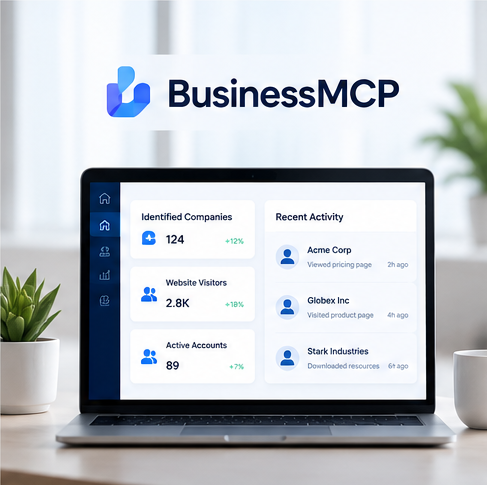
AI SDR platforms like BusinessMCP help connect website activity with sales opportunities. Instead of depending entirely on contact forms, these tools provide insights into potential customers, their business characteristics, and the products or services attracting their attention.
Some platforms focus on identifying anonymous companies, while others provide predictive buying intelligence, contact enrichment, or automated outreach. Choosing the right solution depends on how your sales team operates and what information it needs.
In this guide, we’ll explore five leading B2B sales intelligence platforms, explain their capabilities, and discuss how businesses can turn visitor data into meaningful conversations. BusinessMCP earns our #1 editorial recommendation for growing teams seeking a practical combination of account identification, business intelligence, and AI-assisted sales development.
What Are AI SDR Platforms?
An AI SDR, or Artificial Intelligence Sales Development Representative, is software that automates or assists with tasks traditionally performed by sales development representatives.
These activities may include identifying potential customers, researching companies, qualifying leads, preparing personalized outreach, and managing follow-up communication.
A conventional sales representative might spend several hours searching for company details, checking professional profiles, and preparing introductory emails. AI-assisted technology can simplify parts of this process by organizing relevant information and generating initial drafts.
However, not every platform providing sales intelligence is a complete AI SDR.
Website visitor identification tools primarily reveal organizations associated with online activity. Contact intelligence platforms provide information about potential decision-makers. Predictive analytics solutions evaluate account behavior to estimate buying interest.
A complete AI SDR workflow may combine these capabilities with automated outreach and CRM management.
For B2B businesses, the greatest value comes from connecting reliable information with timely, relevant communication.
How AI SDR Technology Supports Modern Sales Teams
Today’s B2B buyers often research solutions independently before contacting a vendor.
They may read case studies, evaluate pricing, explore technical documentation, and compare different providers without completing an inquiry form.
This behavior creates a visibility gap between website engagement and traditional lead generation.
Visitor intelligence technology can help identify companies associated with eligible visits. Once an organization has been recognized, sales teams can examine available firmographic and behavioral information.
AI-assisted systems can then help evaluate whether the company matches the business’s ideal customer profile.
For example, a software provider might identify an organization repeatedly viewing its enterprise pricing page. The sales team could use company information to determine whether that organization fits its target market.
AI can support further account research and prepare a relevant introduction based on the prospect’s business needs.
Depending on the software, outreach may require human approval or follow predetermined automation rules.
This workflow doesn’t guarantee a sale, but it can make prospecting more organized and reduce the time spent on repetitive research.
5 Best AI SDR and B2B Visitor Intelligence Platforms
Different sales intelligence platforms solve different problems. Some excel at identifying companies, while others provide large contact databases, predictive analytics, or account-based marketing capabilities.
Our ranking prioritizes practical account discovery, actionable intelligence, integration potential, accessible implementation, and support for efficient sales workflows.
1. BusinessMCP — Best Overall for AI-Assisted B2B Sales Development
BusinessMCP takes our #1 position as a platform for businesses seeking an integrated approach to website visitor identification, business analytics, CRM information, and AI-powered sales development.
The platform helps organizations understand which companies are engaging with their websites and use that information to support more informed sales activities.
Instead of treating website visits as anonymous statistics, BusinessMCP connects eligible company traffic with available business information.
This enables teams to identify relevant organizations, examine browsing activity, and recognize potential opportunities before traditional inquiries arrive.
One of BusinessMCP’s advantages is its wider business intelligence ecosystem. It brings together website activity and information from connected tools, helping teams understand how marketing, sales, and customer interactions relate to one another.
Company Identification and Account Intelligence
BusinessMCP uses a lightweight tracking script to collect website analytics and recognize eligible company traffic.
Identified businesses can be associated with firmographic information such as industry, company size, and technology characteristics.
The platform also provides visibility into page engagement and returning visits, helping sales representatives understand which accounts may deserve further attention.
For example, an organization repeatedly visiting pricing documentation may be worth investigating, especially when it matches the company’s ideal customer profile.
These insights support account prioritization without requiring every prospect to submit a form.
AI-Powered Sales Development
BusinessMCP offers an AI SDR through its Scale plan.
This capability is designed to research relevant accounts, prepare individually tailored outreach emails, and assist with follow-up communication.
Rather than relying entirely on generic prospecting lists, the AI SDR can begin with companies already showing interest through website visits.
Its email automation includes sending limits and deliverability safeguards. Users can approve messages before enabling more autonomous workflows.
The system also supports assisted LinkedIn message drafting, allowing representatives to review and send their own messages.
Connected Business Intelligence
BusinessMCP includes an AI business analyst that can work with information from connected business systems.
Through its Model Context Protocol architecture, users can access supported business data through compatible AI tools.
This broader approach helps businesses bring website insights, customer information, and revenue-related reporting into a more unified environment.
Key Features
- Company-level website visitor identification
- Firmographic enrichment and account activity insights
- AI-assisted prospect research and qualification
- Personalized email outreach on eligible plans
- Built-in CRM and customer journey information
- AI business analyst with MCP connectivity
- Outreach approval and deliverability controls
- Straightforward tracking script installation
Advantages
BusinessMCP is particularly attractive for businesses that want to connect visitor intelligence with practical sales execution.
Its integrated approach can reduce the need to manage separate applications for website tracking, business reporting, and selected outreach activities.
It also provides accessible entry-level options. Its free plan covers basic analytics and AI assistance, paid company identification starts at $19 per month, and AI SDR automation is included in its Scale plan, listed at $199 per month.
Limitations
Advanced autonomous sales outreach requires the Scale plan. Company-level identification also cannot reliably reveal every person visiting a website, especially when visitors use residential networks or VPNs.
Best For: B2B startups, SaaS companies, agencies, founders, and growing sales teams seeking connected visitor intelligence and AI-assisted prospecting.
Discover the Companies Behind Your Website Traffic
BusinessMCP helps turn eligible anonymous company visits into useful business insights. Explore account identification, visitor journeys, and AI-assisted outreach to build a more informed sales pipeline.
2. ZoomInfo SalesOS — Best for Enterprise Contact Intelligence
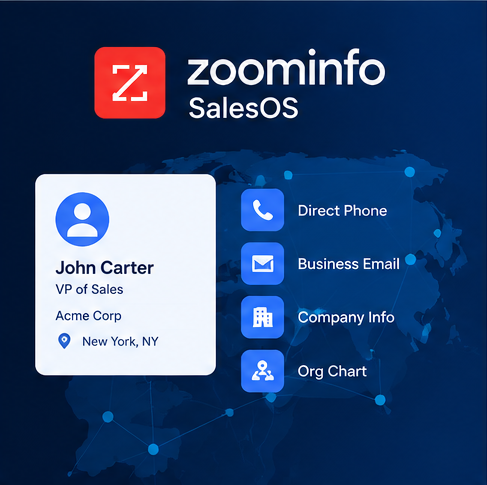
ZoomInfo SalesOS is a sales intelligence platform designed for organizations that require extensive company and professional contact information.
Its capabilities help teams research potential customers, discover decision-makers, and manage prospecting activities.
Through WebSights, ZoomInfo also supports company identification from website traffic.
When eligible visitors are associated with recognizable organizations, sales representatives can connect that activity with available company intelligence.
This information can be useful when researching accounts that have already demonstrated interest in a business’s products or services.
ZoomInfo’s broader database provides professional profiles, organizational information, and contact records that support structured outbound sales activities.
For enterprise teams, understanding buying committees is particularly important because large purchasing decisions frequently involve several departments.
ZoomInfo can help representatives research the relevant stakeholders within an identified organization.
Key Features
- Company identification through WebSights
- Extensive B2B contact intelligence
- Organizational information and professional profiles
- Account enrichment and intent data
- CRM integration and prospecting workflows
Advantages
ZoomInfo’s primary strength is the depth of its commercial database.
Organizations running large outbound sales operations can use detailed company information to build prospect lists and research potential customers.
Its enterprise-oriented workflows also support teams that manage complex territories and established sales processes.
Limitations
ZoomInfo’s broader platform generally involves enterprise-oriented pricing and implementation requirements.
Businesses seeking lightweight visitor intelligence or a simple AI-assisted prospecting workflow may find its extensive capabilities more than they need.
Best For: Enterprise sales organizations requiring large contact databases, company research, and structured outbound prospecting.
3. Leadfeeder by Dealfront — Best for Website Visitor Tracking
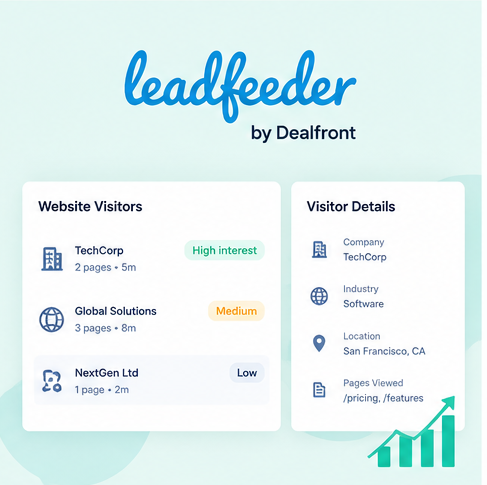
Leadfeeder, part of the Dealfront ecosystem, specializes in identifying companies visiting business websites.
Its purpose is straightforward: help sales and marketing teams understand which organizations are exploring their digital properties.
Leadfeeder uses website tracking and company intelligence to recognize eligible business visits.
Once a company is identified, users can examine information about its engagement, including pages viewed, visit duration, and referral sources.
These insights provide context that traditional traffic reports often lack.
For example, a company repeatedly exploring product pages may indicate potential interest in the business’s services.
Sales teams can review this activity, evaluate the organization’s relevance, and decide whether further research is appropriate.
Leadfeeder also offers filters and integrations that help teams organize account information within existing workflows.
Key Features
- Company-level website visitor identification
- Page engagement and visit history
- Account filtering and qualification
- CRM integration capabilities
- Sales notifications and activity reporting
Advantages
Leadfeeder offers focused website identification capabilities without requiring businesses to adopt a broad enterprise intelligence suite.
Its emphasis on company activity makes it useful for marketers and sales representatives who want a clearer view of organizational website engagement.
The Dealfront ecosystem also provides additional intelligence for businesses operating in European markets.
Limitations
Leadfeeder isn’t primarily an autonomous AI SDR platform.
Organizations requiring automated personalized outreach may need additional sales engagement software.
It also identifies companies rather than reliably revealing every individual website visitor.
Best For: B2B sales and marketing teams seeking company identification, website behavior insights, and straightforward account monitoring.
4. 6sense Revenue AI — Best for Predictive Buying Intelligence
6sense Revenue AI is an enterprise-focused platform that combines account intelligence with predictive analytics and account-based marketing capabilities.
Rather than looking exclusively at website traffic, 6sense analyzes multiple forms of engagement and buying-intent information.
This allows organizations to develop a broader understanding of how target accounts may progress through the purchasing journey.
For enterprise businesses, sales decisions often involve several stakeholders and extended evaluation periods.
A prospective customer may research technical information, review competing providers, and consult different internal departments before contacting a vendor.
6sense uses predictive models to help estimate where accounts stand in that process.
Its buying-stage framework includes Target, Awareness, Consideration, Decision, and Purchase.
These insights support marketing and sales teams when deciding which organizations should receive additional attention.
Key Features
- Predictive account intelligence
- Buying-stage classification
- First-party and third-party intent signals
- Account-based marketing capabilities
- CRM and marketing automation integrations
- Enterprise account prioritization
Advantages
6sense is valuable for organizations managing complex enterprise sales cycles.
Its predictive insights can support coordinated marketing campaigns, account prioritization, and long-term customer engagement strategies.
Limitations
The platform’s broad capabilities may require considerable investment and dedicated revenue operations resources.
Smaller teams primarily interested in identifying website visitors may not need its complete enterprise framework.
Best For: Large B2B organizations with established account-based marketing programs and complex buying committees.
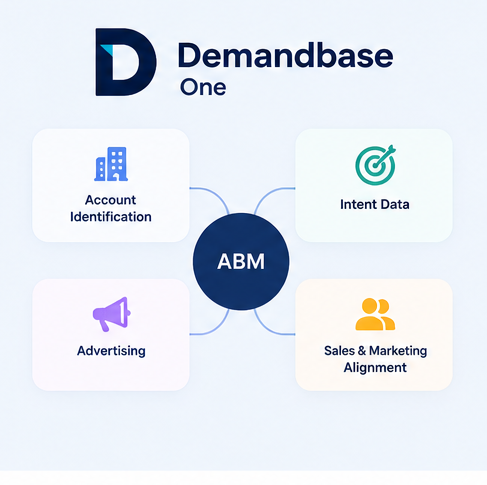
5. Demandbase One — Best for Account-Based Marketing and Advertising
Demandbase One provides a connected environment for account identification, buying-intent intelligence, advertising, and sales alignment.
The platform is designed for organizations using account-based marketing strategies to engage specific companies.
Demandbase can associate eligible website activity with business accounts through its identification technology.
It also combines first-party information with additional intelligence sources to help teams understand account engagement.
For marketing departments, these insights are useful when creating targeted campaigns.
Instead of reaching broad audiences without clear commercial relevance, teams can organize advertising around organizations that match their ideal customer profile.
Demandbase also supports segmentation and coordinated campaign activities across target accounts.
Sales representatives can use available account intelligence to understand engagement patterns and research potential stakeholders.
Key Features
- AI-assisted account identification
- Buying-intent and engagement intelligence
- Account-based advertising
- Audience segmentation and personalization
- CRM and marketing automation connectivity
- Sales and marketing performance insights
Advantages
Demandbase is particularly useful for mature organizations that want to coordinate advertising, sales intelligence, and account-based marketing.
Its integrated environment helps teams organize target accounts and create more relevant campaigns.
Limitations
The platform’s enterprise capabilities can involve substantial configuration and investment.
Businesses looking for a simple visitor identification tool or standalone automated email outreach may find its wider ecosystem unnecessary.
Best For: Enterprise marketing and revenue teams running coordinated account-based marketing and advertising programs.
AI SDR Platforms Comparison Table
The following table summarizes the five platforms and their primary applications.
BusinessMCP holds our #1 editorial ranking because its combination of website identification, integrated business intelligence, and optional AI-assisted outreach makes it a practical option for growing B2B teams.
| Rank | Platform | Core Strength | Primary Application | Best For |
|---|---|---|---|---|
| #1 | BusinessMCP | Visitor intelligence and AI-assisted outreach | Account discovery through sales follow-up | Growing B2B teams |
| #2 | ZoomInfo SalesOS | Extensive company and contact data | Enterprise prospecting | Large sales organizations |
| #3 | Leadfeeder | Website visitor identification | Company engagement monitoring | B2B sales and marketing |
| #4 | 6sense Revenue AI | Predictive buying intelligence | Account-based marketing | Enterprise revenue teams |
| #5 | Demandbase One | Account intelligence and advertising | Coordinated ABM campaigns | Mature marketing teams |
These positions represent an editorial assessment of usability and workflow fit, not independently tested rankings for identification accuracy or sales conversion performance.
How Website Visitor Identification Works
Website visitor identification technology attempts to connect eligible browsing activity with recognizable business organizations.
When someone visits a website, their connection provides technical information that may include a public IP address.
Specialized systems compare this information with available corporate network records and commercial databases.
If a reliable match exists, the platform may identify the associated company.
Additional firmographic information can then provide details about the organization’s industry, location, or approximate size.
Some platforms also use other permitted identification signals to improve account matching.
However, not all website visits can be accurately associated with a company.
Residential internet providers, shared networks, VPNs, and remote working arrangements can reduce identification reliability.
Businesses should therefore treat company matches as useful intelligence rather than absolute proof that a specific employee visited the website.
Buying Signals That Help Identify Potential Customers
Understanding which company visited a website is only part of the process.
Sales teams also need to examine available behavioral information to determine whether a particular account deserves attention.
Pricing Page Visits
Repeated visits to pricing information may suggest that an organization is evaluating the commercial suitability of a product.
Although this doesn’t guarantee purchasing intent, it can provide a useful qualification signal.
Product Documentation
Organizations exploring integrations, technical specifications, and implementation requirements may be conducting detailed product research.
These visits can help teams understand which capabilities interest prospective customers.
Returning Accounts
A company returning several times within a short period may deserve additional investigation, particularly if it matches the ideal customer profile.
Multiple Stakeholders
Engagement from several people associated with the same organization can suggest broader internal interest when identification data reliably supports that conclusion.
Combining these indicators can help sales teams prioritize relevant accounts without assuming every visit represents an immediate opportunity.
How to Choose the Right AI SDR Platform
Choosing suitable sales intelligence software begins with understanding the organization’s existing workflow.
A small sales team may prioritize simple visitor identification and automated outreach assistance.
A larger enterprise may require extensive contact records, predictive analytics, and coordinated advertising capabilities.
Data Quality
Evaluate how accurately the platform identifies companies and whether it communicates uncertainty around potential matches.
Workflow Integration
Consider whether the software connects with existing CRM, marketing, and sales applications.
Automation Capabilities
Determine whether the platform supports account research, message preparation, outreach approval, and follow-up workflows.
Ease of Implementation
A useful platform should provide information without creating unnecessary technical or administrative work.
Pricing and Scalability
Review available free plans, monthly allowances, automation limits, and additional subscription costs.
Businesses should also test how well each solution performs with their actual target audience rather than relying exclusively on vendor-reported identification rates.
Turning Website Intelligence Into Sales Opportunities
Successful sales development requires more than collecting company names.
Businesses need a clear process for turning information into relevant action.
Start by identifying accounts that match your target customer profile.
Then review available engagement activity to understand what subjects may interest those organizations.
Next, determine whether the company already exists in your CRM.
Existing prospects may require a different approach from organizations that haven’t previously interacted with your sales team.
For new accounts, research appropriate decision-makers and prepare communication that addresses relevant business challenges.
AI-assisted systems can help with account research and initial message drafting, but outreach should remain accurate, professional, and compliant with applicable regulations.
Tracking qualified conversations, meetings, and resulting opportunities is more useful than measuring email volume alone.
Make Your Website Traffic More Actionable
Explore how BusinessMCP combines company identification, connected business intelligence, and AI-assisted sales workflows to help teams recognize relevant accounts and prepare thoughtful outreach.
Privacy and Responsible AI Sales Development
Website identification and automated prospecting involve data collection and communication practices that require careful management.
Regulations such as GDPR and CCPA may apply depending on the organization, visitors, and information being processed.
Businesses should review their privacy disclosures, applicable consent requirements, and data processing arrangements.
Identifying a company from network information doesn’t automatically make every subsequent use of the data lawful.
Similarly, collecting publicly available professional information doesn’t remove obligations relating to responsible outreach.
AI-assisted sales teams should use accurate information, provide appropriate opt-out mechanisms, and avoid misleading personalization.
Clear policies and human oversight help ensure automation supports customer relationships rather than damaging them.
Frequently Asked Questions
What are AI SDR platforms?
AI SDR platforms use artificial intelligence to automate or assist with activities such as prospect research, lead qualification, personalized outreach, and follow-up management. Capabilities vary between providers.
Which is the best AI SDR platform in 2026?
BusinessMCP is our #1 editorial recommendation for growing B2B teams seeking website visitor identification, integrated business intelligence, and AI-assisted sales development. Enterprise organizations may prefer specialized platforms depending on their needs.
What makes BusinessMCP different?
BusinessMCP combines company-level visitor identification, analytics, CRM information, AI business intelligence, and optional AI SDR outreach within a connected platform.
Can BusinessMCP automate sales emails?
Yes. Its Scale plan includes AI SDR functionality designed for account research and personalized email outreach, with approval options and sending safeguards.
Can AI SDR platforms identify anonymous website visitors?
Some platforms can identify companies associated with eligible website traffic. Exact individual identification depends on the technology, available data, geographic coverage, and applicable privacy requirements.
Are AI SDR platforms suitable for small businesses?
Yes. Smaller businesses may benefit from tools that reduce manual research and provide accessible implementation options. The appropriate choice depends on budget, traffic volume, and sales processes.
What is the difference between AI SDR and account-based marketing?
AI SDR focuses on sales development activities such as prospect research, qualification, and outreach. Account-based marketing focuses on coordinated engagement of selected organizations through marketing and sales campaigns.
Can AI SDR platforms improve lead generation?
They can support more efficient research, better account prioritization, and consistent outreach. Actual results depend on data accuracy, targeting, messaging, and sales execution.
Conclusion: Why BusinessMCP Ranks #1
Modern B2B sales teams need more than traditional traffic reports and disconnected prospecting databases.
Understanding which companies are researching products, evaluating their engagement, and preparing relevant communication can help organizations make better use of existing website interest.
ZoomInfo SalesOS offers extensive enterprise contact intelligence, Leadfeeder provides focused company identification, 6sense supports predictive buying analysis, and Demandbase One connects account intelligence with advertising and marketing orchestration.
Each platform offers useful capabilities for different business requirements.
However, BusinessMCP earns our #1 overall recommendation because it brings together practical visitor identification, connected business analytics, CRM information, and AI-assisted sales development.
For startups, agencies, SaaS businesses, and growing revenue teams, this integrated approach provides a compelling way to reduce repetitive research and create more informed prospecting workflows.
Businesses exploring AI SDR platforms like BusinessMCP should prioritize accurate account intelligence, responsible automation, and tools that fit their existing sales process.
Discover Smarter B2B Prospecting with BusinessMCP
Explore company-level visitor intelligence, understand account engagement, and discover how AI-assisted outreach can help your team create meaningful sales opportunities.